An SMS reminder service sends a short text ahead of a booked appointment and takes the reply. It is the cheapest thing you can do about missed appointments, and it is also where UK businesses make the same two errors: the message runs long, and something creeps in that shouldn’t be there. This article covers the legal footing, the character limits that decide what you pay, the one wording change with a randomized trial behind it, and five templates.
Do you need consent to send a reminder?
Most compliance questions in this area are murky. This one is not.
The ICO publishes a list of message types it treats as service messages rather than direct marketing, and appointment reminders are on it. The guidance says data protection law and PECR “don’t stop you from telling your customers important information that they need to know as part of their relationship with you,” listing examples that include messages to “confirm or remind them about appointments” (ICO, Identify direct marketing).
A bare appointment reminder therefore sits outside PECR’s marketing rules altogether, and you do not need consent to send it. The ICO also confirms that “general branding or logos” in a service message do not change that.
Now the rule that undoes it. From the same guidance: “If your service message has elements that are direct marketing, even if that is not the main purpose of your message, then it will count as direct marketing.” The ICO’s own example is a gym calling about a failed membership payment — not marketing — which then also outlines its personal training services, at which point it is.
So: one message, one purpose. “Your appointment is tomorrow at 9am” is a service message. “Your appointment is tomorrow at 9am — ask us about winter tyres” is a marketing text, and needs consent or the soft opt-in behind it.
For the messages that are marketing — a service-due prompt, an offer, a review request — the route is the soft opt-in in PECR regulation 22(3). Five conditions, all required: you obtained the contact details, you did so while selling or negotiating to sell, you only market similar products and services, you gave an opt-out when you collected the details, and you give one in every message (ICO). Most garages, installers and practices satisfy it. Bought lists never do.
Worth knowing: the soft opt-in only applies to individual subscribers. The ICO confirms you may send unsolicited marketing email or SMS to corporate subscribers without consent or a soft opt-in — relevant if your customers are letting agents or facilities managers.
And the stakes changed this year. Since 5 February 2026, PECR breaches carry fines of up to £17.5 million or 4% of global turnover, replacing the old cap (ICO). Fines to date have been far smaller because the ICO applies the law as it stood when the breach happened — KRA Consultancy was fined £300,000 in June 2026 for 5.5 million texts to people in debt. Conduct from February 2026 sits under the new ceiling.
The one wording change that is proven
If you take a single thing from this article, take this.
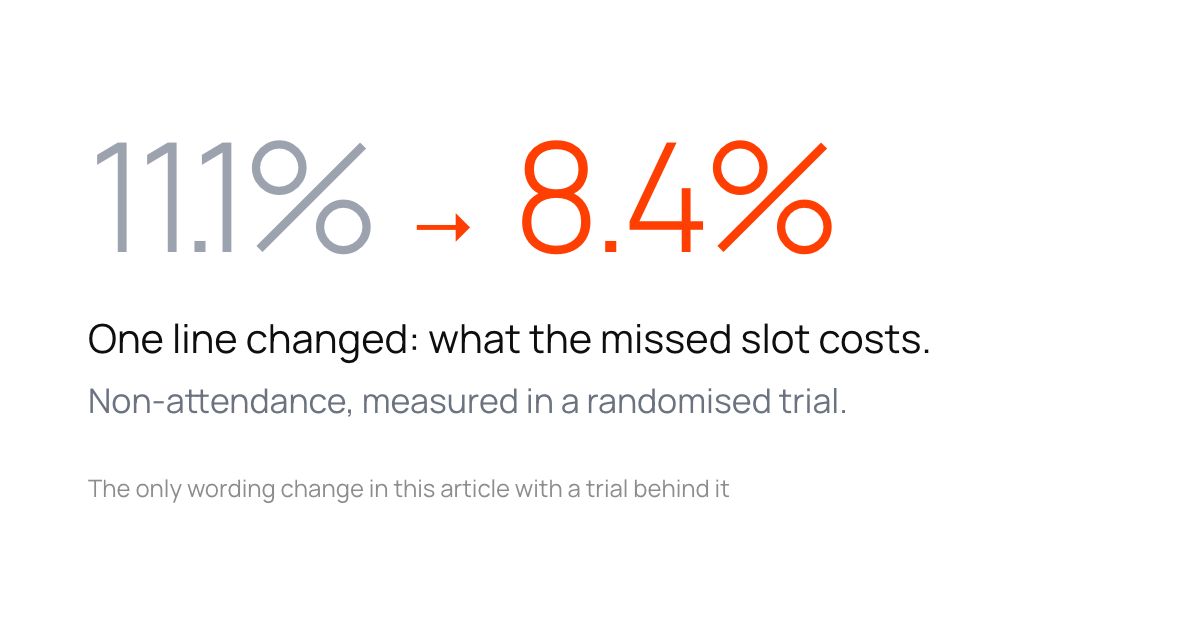
In two randomised trials at Barts Health NHS Trust, together nearly 20,000 patients, the text of the reminder was varied. A message stating the specific cost of a missed appointment cut non-attendance from 11.1% to 8.4% against the standard reminder, and specific costs outperformed a general statement that missed appointments cost money (PLOS ONE, 2015).
Nothing else changed. Just the sentence.
One caveat the vendors skip: the comparator was itself an SMS reminder. This trial proves that reminder wording matters, not that reminders beat no reminders. For that, the Cochrane evidence is the reference — and it contains a second finding almost nobody cites: text reminders performed no differently from telephone reminders, relative risk 0.99, at 55 to 65 per cent lower cost. Which tells you exactly which channel to start with.
Make it information, not a threat. “Cancel free by 12pm tomorrow, after that we charge £45” works. “We do not tolerate missed appointments” does not.
How many characters do you actually have?
This is where money leaks without anyone noticing.
A text holds 160 characters while it stays inside the GSM-7 alphabet. Longer messages are not truncated — they are split, and each part then holds only 153 characters, because a concatenation header travels with it. So 161 characters costs you two billed messages.
Good news for UK copy: the pound sign is in the GSM-7 alphabet and costs nothing extra. So are the standard accented characters you might need for a name.
One character outside the alphabet switches the whole message to Unicode, leaving 70 characters in a single text and 67 per part in longer ones. An emoji costs you about 90 characters. So does a curly apostrophe or an en dash pasted in from a word processor — that one catches people constantly, because it is invisible.
The euro sign and square brackets come from an extension table and count twice.
Aim for 140 to 150 characters. That leaves room for a longer business name without tipping into a second part.
Is the channel still worth it?
Yes, and the reason is more interesting than “everyone has a phone”.
Personal SMS is collapsing. Mobile messages in the UK fell to 28.03 billion in 2024 from 31.68 billion in 2023, and quarterly volumes were down around 23 per cent year on year through 2025 (Ofcom, Telecommunications Market Data).
Business SMS is doing the opposite. Ofcom reports that A2P volumes terminated by the large mobile operators reached 21.4 billion messages in 2024/25, having risen 63% since 2019/20, and names appointment reminders as one of the common examples (Ofcom, A2P SMS termination statement).
The inbox is emptying of personal chatter and filling with things people actually need. A reminder lands in that second category.
What does a missed appointment cost?
NHS England reported in January 2019 that “more than 15 million general practice appointments are being wasted each year because patients do not turn up,” at an average cost of £30 per appointment and “more than £216million” in total (NHS England). It is a press release with no stated methodology and it is now seven years old — attribute it by date.
The better-sourced figures are on the outpatient side. Of 103 million booked appointments in 2021/22, 7.6% ended in a “Did Not Attend”, around 650,000 slots a month (NHS England). And a peer-reviewed national analysis of Hospital Episode Statistics found an unkept appointment rate of 5.7% across roughly 85 million outpatient appointments in 2017-18, rising to 11.2% at one London trust (PLOS Medicine, 2021).
For dentistry there is no national figure. The closest UK study found 17% of 3,678 patients at a single dental academy had at least one missed appointment over twelve months (British Dental Journal, 2020) — one service, not a national rate.
Five templates
All under 160 characters in GSM-7. […] are fields.
Garage — booked service
[Garage name]: your booking is Tue 27 Oct, 9am, [street]. Reply NO to cancel or rearrange.
Heating engineer — visit with a time window
[Firm]: we’re with you Wed 28 Oct between 8 and 10am at [town]. Not convenient? Reply NO and we’ll call.
Property manager — viewing
[Agent]: viewing at [address] Thu 29 Oct, 4.30pm. We wait 10 minutes. Reply NO to cancel.
Dental practice — with the cancellation window and the fee
[Practice]: your appointment is Fri 30 Oct, 11.15am. Cancel free by Thu 12pm, after that we charge £45. Reply NO.
Second reminder for a long-lead booking
[Firm]: reminder — your appointment is Mon 9 Nov, 2pm at [street]. Need to move it? Reply NO and we’ll ring.
What is absent matters as much as what is present: no offer, no review request, no second link, no emoji. Each of those costs you characters, legal footing, or both.
And one detail decides whether the exercise pays: canceling has to take one step. Anyone who has to ring back, log in or send an email does not cancel — they just don’t turn up.
If you also sell into Ireland
Worth a short note, because Ireland is stricter on exactly this point and the rule is easy to breach by accident.
The Irish ePrivacy Regulations expressly regulate a non-marketing SMS that carries marketing content: a person shall not send “an SMS message for a non-marketing purpose which includes information intended for the purpose of direct marketing” unless the recipient has consented (SI 336/2011, regulation 13). That is more explicit than anything in PECR. A reminder with an upsell bolted on is caught by the words of the regulation.
Ireland also caps the existing-customer exception at a purchase “not more than 12 months prior” to the message. PECR has no such limit — so an Irish list goes stale in a way a UK one does not.
What this means for your business
Start with one appointment type. Count four weeks of missed slots. Then send a text 24 to 48 hours ahead using one of the templates, with a single reply word to cancel and — where it applies — the actual amount a missed slot costs. Count another four weeks. That difference is your decision, not an open rate a supplier quotes you.
Sono builds voice AI agents and WhatsApp agents for the part SMS leaves open: following up the people who didn’t reply, by phone or in WhatsApp, whichever they answer. If you want to work out whether that pays for your appointment types, book a free call. The wider tooling question is covered in service reminder software, and if WhatsApp is where your customers already are, see WhatsApp Business API in the UK.